
DVSA Driver Walkaround Checks: The Daily Routine That Avoids Prohibition Notices

One missed crack, one duff bulb, one loose load strap — and the next roadside stop can end your day. The driver walkaround check is the daily routine DVSA expects every commercial driver to complete before moving a vehicle. Skip it, log it wrong, or fail to report a defect and you risk a prohibition notice, a fine, and an O-licence hearing. This guide walks through what the check covers, why it stops PG9s landing on your fleet, the mistakes that cost operators most, and how digital logging removes the paperwork risk.
What Is a DVSA Walkaround Check?
A driver walkaround check is a structured pre-use inspection of an HGV, PSV, or LGV carried out by the driver before the vehicle is used on the road. DVSA mandates it under the operator licensing regime — the driver and the operator share legal responsibility.
The check covers external, internal, and load-related items. DVSA publishes daily HGV walkaround check guidance [opens in new tab], with an equivalent guide for PSV operators, covering lights, tyres, brakes, mirrors, steering, fuel and oil leaks, and load security.
Why Walkaround Checks Avoid Prohibition Notices
A DVSA prohibition (PG9) is issued at the roadside when an examiner finds a defect serious enough to make a vehicle unsafe. Prohibitions can be immediate (vehicle off the road on the spot) or delayed (must be fixed within a set period).
DVSA grades roadside defects against published criteria — see the DVSA Categorisation of Defects guide [opens in new tab]. The walkaround catches the same defects before the vehicle leaves the yard — turning a £200 fine, a stranded load, and a black mark on the operator’s OCRS score into a planned repair.
Operators with a clean walkaround record see fewer roadside stops because DVSA’s risk-scoring (OCRS) targets fleets with poor compliance history. The walkaround is the cheapest insurance against that targeting.
The Daily Walkaround Routine: What to Inspect
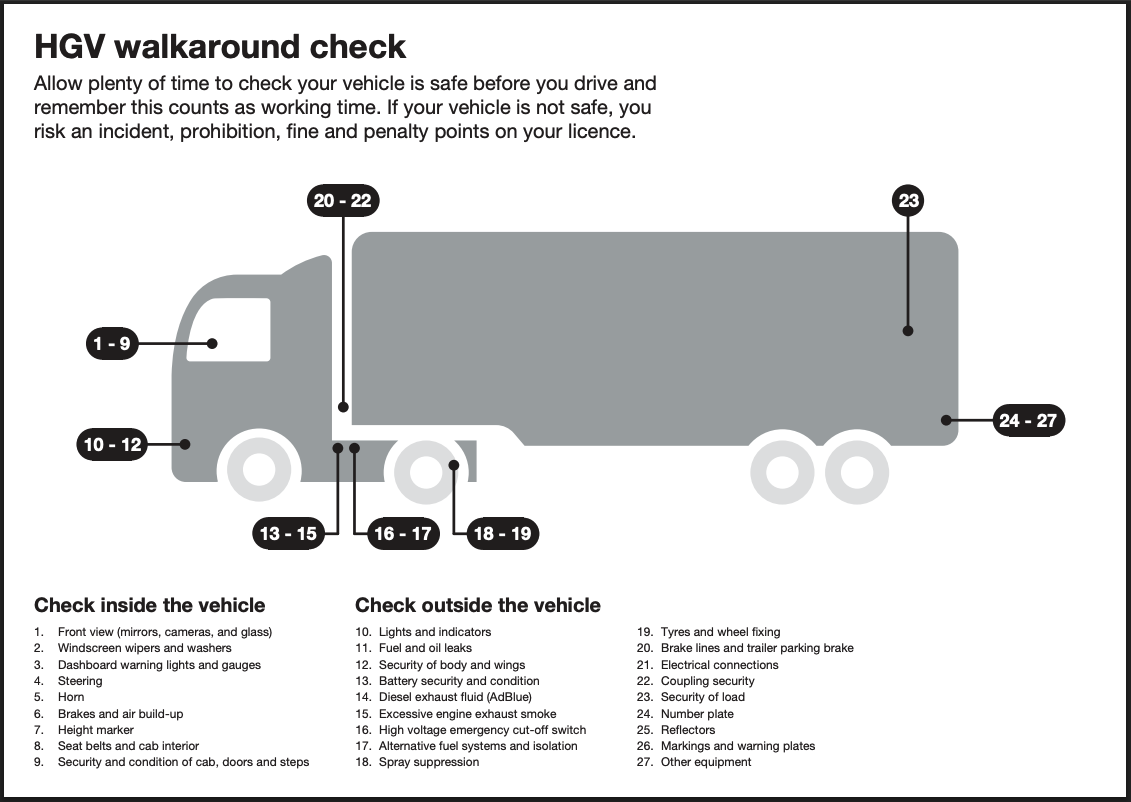
The DVSA-approved daily walkaround follows a consistent order so nothing gets missed. A solid routine covers:
- Lights and indicators — all bulbs working, lenses clean and intact, no cracks.
- Tyres and wheels — tread depth above legal minimum, no cuts or bulges, wheel nuts secure.
- Brakes and air pressure — no audible leaks, warning lights off, parking brake holds.
- Steering and suspension — no excessive play, no fluid leaks, full lock-to-lock check.
- Mirrors and glass — no cracks obstructing view, all mirrors adjusted and secure.
- Load security — straps, chains, and tail-lifts inspected; load distributed within limits.
- Documents and exhaust — O-licence disc, tachograph working, no excessive emissions.
Defects must be logged, reported, and signed off — even when a defect is rectified before departure. DVSA can ask for records going back 15 months at a traffic commissioner hearing.
Common Mistakes That Trigger PG9 Notices
Most prohibition notices land for predictable reasons. Operators we work with see these five most often:
- Tick-and-flick paper sheets — drivers signing off without actually inspecting.
- Missing defect reports — faults spotted but never recorded, so the next driver inherits them.
- Lost paperwork — compliance auditors can’t find the 15-month history.
- No photographic evidence — disputes at roadside have no record to back the driver.
- Inconsistent format — different drivers using different forms across the same fleet.
Worried your current walkaround process leaves gaps? See your defect history, driver compliance, and audit trail in one dashboard — book a free workMule demo.
How Digital Tools Make Walkaround Checks Compliant
A digital vehicle inspection app replaces tick-sheets with a guided checklist on the driver’s phone. Every item is timestamped, every defect is photographed, every sign-off is geo-tagged.
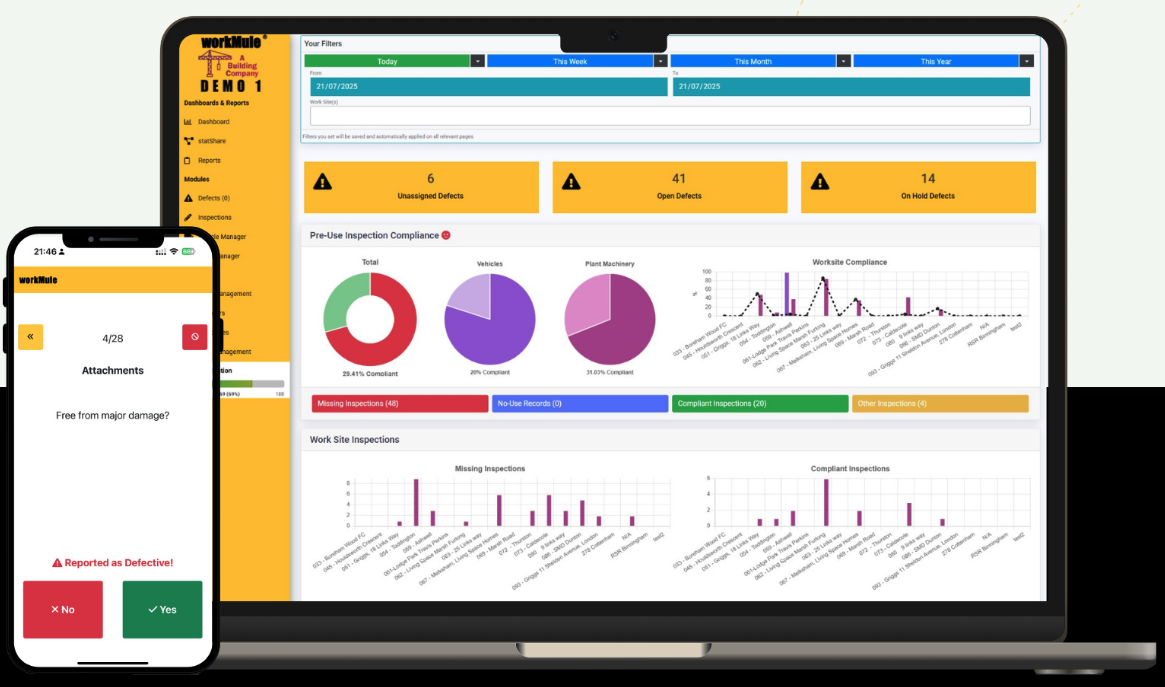
The shift removes the three biggest failure points in paper walkarounds:
- Audit trail — every check is searchable for the full 15-month window — no lost forms.
- Defect escalation — fleet managers see faults in real time, not at end of shift.
- Consistency — every driver works from the same DVSA-aligned checklist across every vehicle.
workMule’s plant and vehicle inspection app runs offline, syncs when reception returns, and exports an audit-ready report in seconds — built around DVSA’s walkaround structure from day one.
FAQs
How often does a driver walkaround check need to be done?
Every time the vehicle is used, before it leaves the yard or depot. A walkaround applies to the start of each driver’s shift — if a new driver takes over the same vehicle later, they complete their own walkaround. DVSA expects a fresh, signed check for every duty period.
What happens if a driver skips the walkaround?
Skipping a walkaround puts both the driver and the operator at risk. At a roadside stop, the driver can be fined and the vehicle prohibited. At a traffic commissioner hearing, the operator’s licence can be curtailed, suspended, or revoked — particularly where missed walkarounds correlate with mechanical defects.
Are walkaround checks legally required for vans under 3.5 tonnes?
DVSA’s formal walkaround requirement applies to HGVs and PSVs under O-licence. However, employers have a duty under PUWER and the Health and Safety at Work Act to ensure all work vehicles — including LGVs and vans — are safe and roadworthy. Most fleet operators apply the same walkaround discipline to vans as a matter of policy.
How long must walkaround records be kept?
DVSA expects walkaround records — defect reports and rectification sign-offs — kept for at least 15 months. Digital systems store them indefinitely and produce traffic commissioner audits in one click.
Conclusion
The driver walkaround check is the cheapest piece of compliance any commercial operator runs — and the most powerful way to keep PG9s off the fleet. The routine catches defects before DVSA does, builds the 15-month audit trail, and protects the O-licence. The only real question is whether the records hold up when an inspector asks for them.
Ready to swap paper tick-sheets for a DVSA-aligned digital walkaround? Book a workMule demo and we will walk your fleet through it.